MABBI – Research conducted by Aditya Nugroho, Iskandar Z Siregar, Deden Derajat Matra, and Ulfah J. Siregar from IPB University entitled Transcriptome dataset of gall-rust infected Sengon (Falcataria falcata) seedlings using long-read PCR-cDNA sequencing.
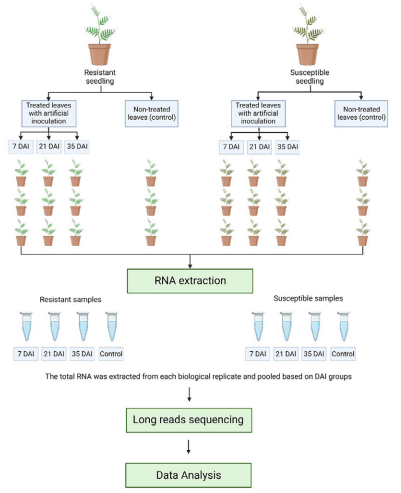
Sengon ( Falcataria falcata ) is an economically important legume tree widely cultivated in community forests, especially in Java Island. However, attacks of gall rust disease by Uromycladium falcatariae is difficult to manage. Understanding sengon genes expressions when artificially infected with gall rust fungi can help unravel its resistance mechanisms. Total RNA was extracted from sengon seedlings samples inoculated with U. falcatariae fungi at 7, 21, and 35 days after inoculation (DAI) and from the control group. Total RNA sequencing was performed using the PCR-cDNA Sequencing protocol (SQK-PCB109) from Oxford Nanopore Technologies. The RNA-Seq obtained varies from 1.3 million to 1.9 million total reads. The assembled full-length transcript was constructed using the RATTLE program, resulting in 21,819 transcripts. The TransDecoder program used to define open reading frames (ORFs) generated 2,342 transcripts, of which 34.15% were 5 prime_partial, 8.15% were 3 prime_partial, 8.5% were internal, and 49.14% were complete. Analysis of differentially expressed genes (DEGs) between resistant and susceptible seedlings, found that 1,013 genes that were upregulated and 1,130 genes that were down-regulated in the resistant lines. The transcriptome data discussed in this article have been deposited in the DDBJ with accession number DRA015681.
Read More:
https://www.sciencedirect.com/science/article/pii/S2352340923009587?via%3Dihub
Leave a Reply